What policy actually says
There is no broad United States or European rule that says a reusable dual chamber pen must be selected instead of a disposable injection device. Current policy is more demanding in a different way. Manufacturers and pharmaceutical project owners are expected to understand the device lifecycle, manage risk, control design and suppliers, explain critical user steps, maintain traceability and support post market responsibilities.
This changes how a reusable dual chamber pen policy discussion should be presented. The strongest position is not a claim that regulators prefer reuse. The stronger position is that a reusable platform can make its lifecycle, replacement cartridge model, interface controls, instructions, packaging and evidence pathway visible to the buyer.
A reusable dual chamber pen becomes more distinctive only when the supplier can document how the reusable mechanism, disposable cartridge, needle, packaging and user steps are controlled.
FDA QMSR in 2026
The United States FDA Quality Management System Regulation became effective on 2 February 2026. FDA states that the revised 21 CFR Part 820 incorporates ISO 13485:2016 by reference and aligns the United States device quality framework more closely with international quality management systems. FDA also moved to a new inspection process under QMSR.
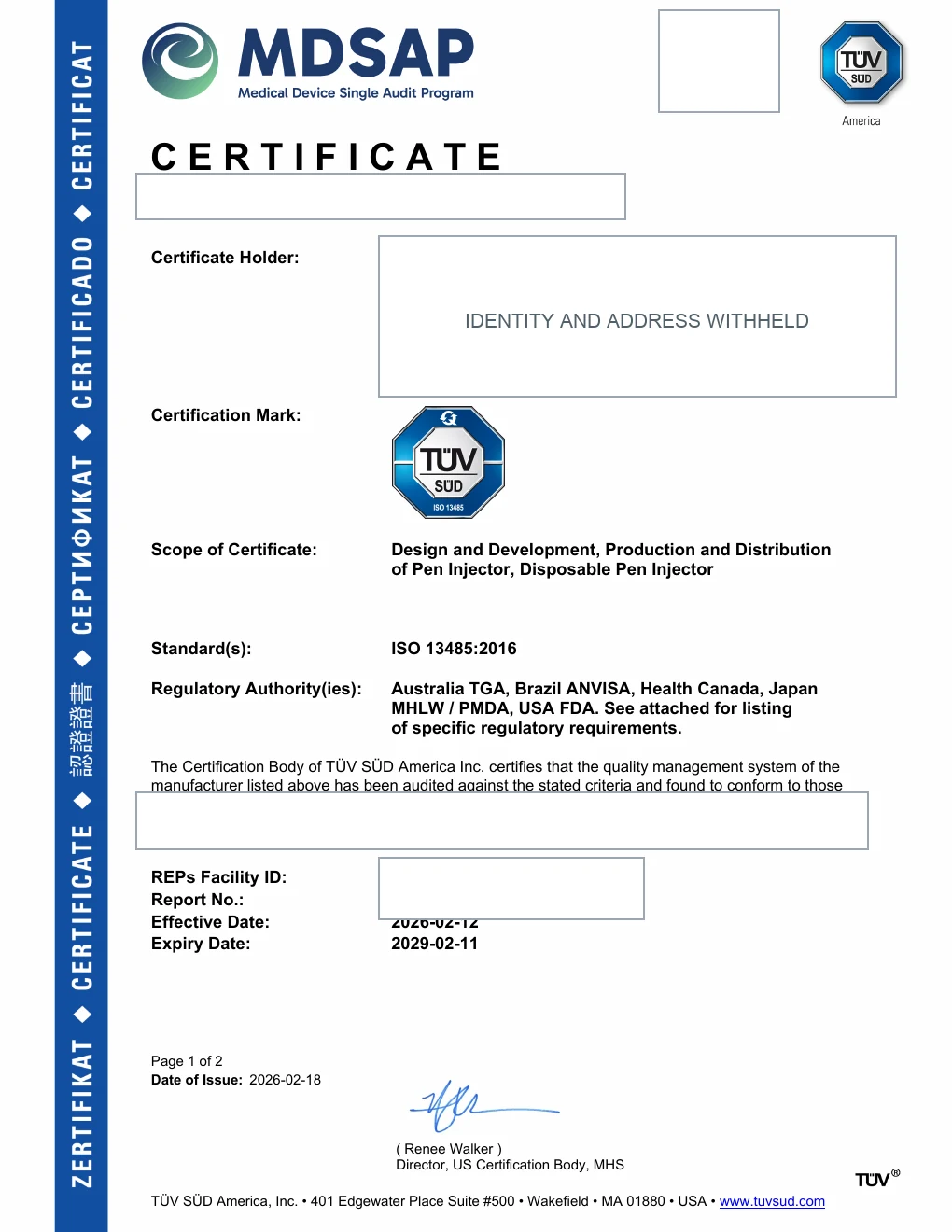
For teams researching an FDA QMSR pen injector strategy, the commercial implication is straightforward. A supplier should be able to explain design and development responsibilities, risk based decisions, supplier controls, changes, production evidence and the relationship between the finished device and its components. A catalogue photograph and a certificate logo are not enough.
A reusable platform may stand out because it creates a stable technical system that can be described across the pen body, cartridge interface, replacement cartridge, needle and packaging. That advantage exists only if configuration control is strong. Frequent undocumented changes or unclear manufacturing roles would weaken the same platform.
EU MDR lifecycle expectations
The EU Medical Device Regulation follows a lifecycle approach. It requires an appropriate quality management system and ongoing post market surveillance. The regulation also includes information requirements for devices described as reusable, including appropriate processes that allow reuse where applicable. The exact obligations depend on the device's intended purpose, classification, design and regulatory pathway.
An EU MDR reusable device discussion therefore needs more than the word reusable. The project should define intended lifetime, use cycles, maintenance or cleaning expectations, consumable components, cartridge replacement, instructions and the information needed for safe use. If a pen is intended to be retained while cartridges and needles are replaced, that operating model should be clear in the technical documentation and user interface.
This can make a reusable dual chamber pen more visible in procurement because the platform naturally invites a lifecycle discussion. Buyers can ask how many elements are retained, which elements are replaced, how changes are controlled and how post market information will be connected to the correct device configuration.
Combination product human factors
FDA guidance on human factors for combination products explains that the unique interaction between drug and device constituent parts affects the human factors process. For a combination product pen injector, critical tasks may include selecting the correct product, attaching a needle, preparing the system, setting a dose, confirming delivery, replacing a cartridge, storing the device and following cleaning instructions.
A dual chamber system may add preparation steps before dosing. This can be a commercial differentiator when the user interface is coherent, but it is also a risk that must be studied. A reusable pen should not be promoted as easier or safer without usability and validation evidence. What can be promoted is a structured approach to identifying critical tasks and linking them to the selected cartridge and instructions.
EU packaging policy
The EU Packaging and Packaging Waste Regulation entered into force in February 2025 and applies from 12 August 2026. It increases the focus on packaging minimisation, recyclability, labeling and waste responsibility. The regulation includes different requirements and exceptions for certain pharmaceutical and medical device packaging, so a medical device packaging regulation EU review must be specific to the package and market.
The policy does not make a reusable pen automatically compliant or sustainable. However, it gives buyers another reason to compare a reusable device body plus replacement cartridges against repeated supply of a complete disposable device. A sustainable injection device claim would require evidence covering the device body, cartridge, needle, sterile barrier where applicable, secondary packaging, transport and end of life route.
| Policy pressure | How a reusable platform can respond | Evidence still required |
|---|---|---|
| Packaging minimisation | Separate durable device and replacement component packaging strategies. | Actual packaging weights, materials, safety needs and market rules. |
| Recyclability | Document material and packaging structure for each supplied component. | Local collection, contamination and recycling feasibility. |
| Lifecycle control | Define retained and replaced elements across the intended use model. | Use cycles, maintenance, cleaning and performance evidence. |
| Supplier quality | Maintain controlled pen cartridge and needle interfaces. | QMS scope, supplier controls, change control and records. |
| User safety | Map preparation, dosing, replacement and storage tasks. | Human factors and configuration specific validation. |
EUDAMED and traceability
The European Commission states that the first four EUDAMED modules became mandatory from 28 May 2026, covering actor registration, UDI and device registration, notified bodies and certificates, and market surveillance. This does not create a special EUDAMED pen injector advantage, but it increases the practical importance of consistent device identity, certificate information and lifecycle records.
A reusable platform may stand out when product families, configurations and replacement components are clearly mapped. It may become harder to manage when one commercial name hides multiple uncontrolled pen, cartridge or packaging variants. Traceability should therefore be designed into the product and commercial structure rather than added after launch.
How the platform can stand out
- Define the lifecycle. State what is reused, what is replaced and what is single use.
- Control the interfaces. Connect pen, cartridge, stopper, needle and packaging drawings to one configuration.
- Document critical tasks. Cover preparation, dose setting, injection, cartridge replacement, storage and cleaning where applicable.
- Build a market specific evidence pack. Separate public certificate previews from controlled project documents.
- Measure packaging instead of using green language. Compare material, packaging and logistics using real data.
- Maintain traceability. Keep product identity, variants, changes and supplier responsibilities clear.
This is how policy can make a reusable dual chamber pen more prominent: not by granting it automatic preference, but by rewarding platforms that can explain their full system and lifecycle. Continue with the reusable pen benefits article, quality documentation pathway and supplier qualification checklist.